
Investment Trends for 2026: Spotlighting U.S. Growth Sectors Poised for Significant Expansion
As we navigate the dynamic global economic landscape, forward-thinking investors are already setting their sights on 2026, seeking out the next wave of opportunities. The United States, with its robust innovation ecosystem, diverse economy, and strong consumer base, continues to be a fertile ground for significant growth. Identifying the key US growth sectors early is paramount for strategic portfolio positioning and maximizing returns. This comprehensive analysis delves into the industries expected to lead the charge, driven by technological advancements, evolving consumer demands, and strategic governmental initiatives.
The year 2026 promises to be a pivotal period, shaped by trends that are already taking root. From the relentless march of artificial intelligence to the critical shift towards sustainable energy, and the ever-expanding frontiers of healthcare, understanding these foundational shifts will illuminate the most promising investment avenues. Our goal is to provide a detailed roadmap for investors, highlighting not just what these sectors are, but why they are poised for substantial growth and what specific areas within them offer the most compelling prospects. This deep dive into US growth sectors will equip you with the knowledge to make informed decisions in a rapidly evolving market.
The Technological Revolution Continues: AI, Quantum Computing, and Cybersecurity
Technology remains an undisputed leader among US growth sectors, and 2026 will see an acceleration of several key sub-sectors. Artificial Intelligence (AI) is no longer a futuristic concept; it’s an integral part of modern business operations, consumer services, and scientific research. The demand for AI solutions, from advanced analytics and machine learning platforms to natural language processing and computer vision, is exploding across every industry. Companies that are developing foundational AI models, specialized AI applications for niche markets, or providing the infrastructure (e.g., advanced semiconductors, cloud computing optimized for AI) will see exponential growth. Investors should look for firms with strong intellectual property, demonstrable use cases, and a clear path to commercialization.
Quantum computing, while still in its nascent stages, is rapidly progressing and holds the potential to revolutionize fields ranging from cryptography and drug discovery to financial modeling. While mass market adoption is still some years away, the foundational research and development phase is attracting significant investment. Companies making breakthroughs in quantum hardware, software, and algorithms are positioned for long-term growth. Investing in this area requires a higher risk tolerance but offers the promise of extraordinary returns for those who identify the future leaders. This sector, though speculative, is undeniably a part of the future of US growth sectors.
Cybersecurity, a perennial concern, is set to become even more critical. As digital transformation permeates every aspect of life and business, the sophistication and frequency of cyber threats continue to escalate. Enterprises, governments, and individuals are increasingly investing in robust cybersecurity solutions to protect their data, infrastructure, and privacy. This includes everything from advanced threat detection and response systems to identity management, cloud security, and operational technology (OT) security. Companies offering innovative, adaptive, and comprehensive cybersecurity platforms will thrive. The continuous arms race between attackers and defenders ensures that cybersecurity will remain a high-growth area for the foreseeable future, making it a cornerstone of the US growth sectors narrative.
Healthcare Innovation: Biotechnology, Telemedicine, and Personalized Medicine
The healthcare sector in the U.S. is a behemoth, constantly evolving and driven by demographic shifts, technological breakthroughs, and an unwavering demand for improved quality of life. By 2026, several segments within healthcare will stand out as significant US growth sectors.
Biotechnology and Gene Therapies
Biotechnology, particularly in the realm of gene editing and cell therapies, is experiencing a golden age. Advances in CRISPR technology, mRNA vaccines, and regenerative medicine are paving the way for revolutionary treatments for previously incurable diseases. Companies at the forefront of developing these therapies, as well as those providing the tools and services for biotech research (e.g., lab equipment, bioinformatics software), are expected to see substantial growth. The regulatory environment is becoming more adaptive to these innovations, further accelerating their market entry. This area represents not just medical advancement but also a profound economic opportunity within US growth sectors.
Telemedicine and Digital Health
The pandemic significantly accelerated the adoption of telemedicine and digital health solutions, a trend that shows no signs of slowing down. By 2026, telemedicine is expected to be a standard component of healthcare delivery, offering convenience, accessibility, and efficiency. Investment opportunities abound in platforms facilitating virtual consultations, remote patient monitoring devices, AI-powered diagnostic tools, and digital therapeutics. Companies that can seamlessly integrate these technologies into existing healthcare systems and demonstrate measurable improvements in patient outcomes will be particularly attractive. The focus on preventive care and chronic disease management through digital means will further fuel this segment’s growth as a key part of US growth sectors.
Personalized Medicine
The move from a one-size-fits-all approach to highly personalized treatments based on an individual’s genetic makeup, lifestyle, and environment is gaining momentum. Personalized medicine leverages genomics, proteomics, and advanced data analytics to tailor therapies, leading to more effective and safer treatments. This includes pharmacogenomics, which helps predict how patients will respond to specific drugs, and targeted therapies for cancer and rare diseases. Companies involved in genetic testing, genomic sequencing, and the development of personalized drug delivery systems are poised for significant expansion. This bespoke approach to healthcare is transforming patient care and creating immense value, solidifying its place among the leading US growth sectors.
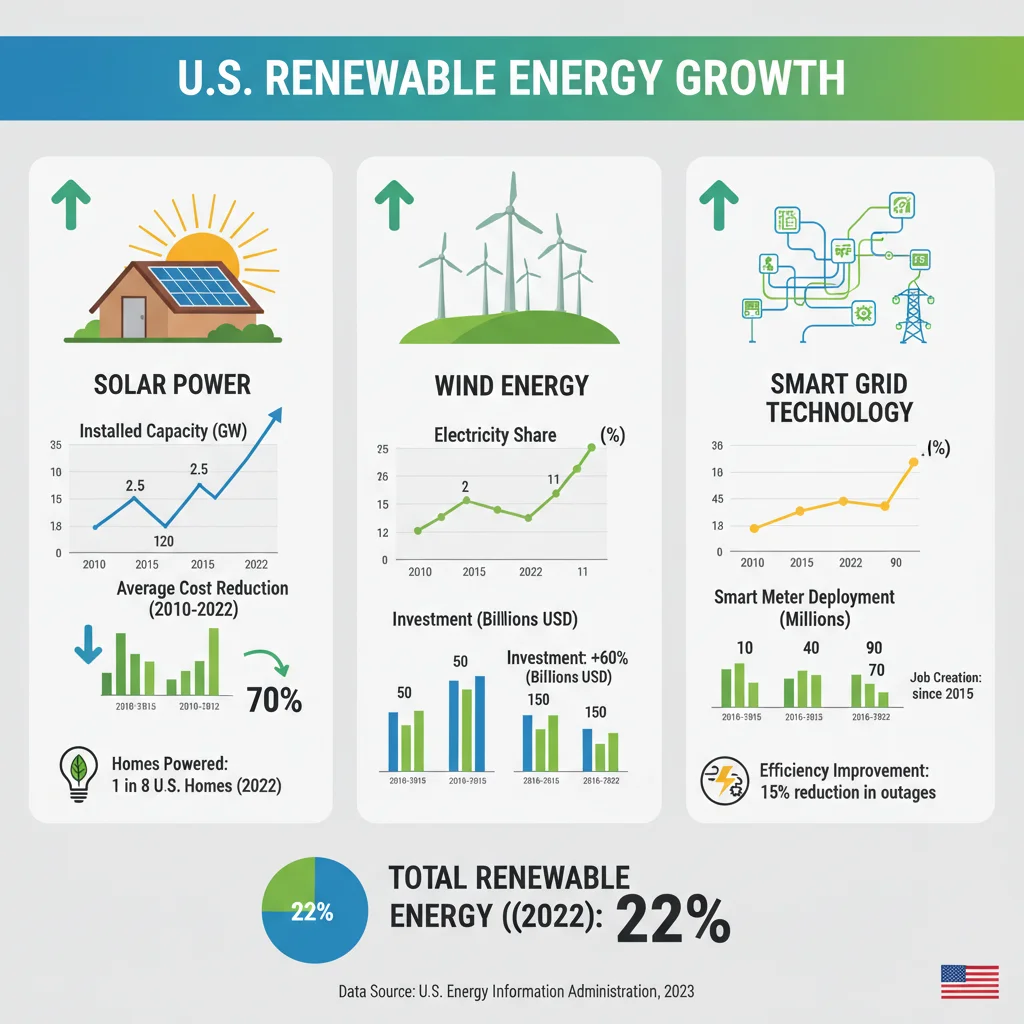
Sustainable Future: Renewable Energy and Green Technologies
The global imperative to combat climate change, coupled with increasing energy demands and decreasing costs of renewable technologies, positions sustainable energy and green technologies as dominant US growth sectors for 2026. Government incentives, corporate sustainability goals, and consumer preferences are all converging to create a powerful tailwind for this industry.
Solar and Wind Power
Solar photovoltaic (PV) and wind power generation continue to expand at an unprecedented rate. Advancements in efficiency, storage solutions (e.g., advanced battery technology), and grid integration are making these sources increasingly competitive and reliable. Investment opportunities exist not only in the developers and operators of large-scale solar and wind farms but also in companies manufacturing key components, providing installation services, and developing innovative energy storage solutions. The U.S. has vast untapped potential in both solar and wind resources, ensuring sustained growth in these areas.
Electric Vehicles (EVs) and Charging Infrastructure
The transition to electric vehicles is accelerating, driven by technological improvements, expanding model availability, and supportive government policies. This shift creates a massive investment opportunity beyond just EV manufacturers. The demand for charging infrastructure – from public charging networks to home charging solutions – is set to explode. Companies involved in battery technology, rare earth material processing, smart grid integration for EV charging, and even autonomous driving systems within EVs will be key players in this burgeoning market. The entire ecosystem supporting EVs is a significant part of the future US growth sectors.
Carbon Capture and Sustainable Materials
Beyond energy generation, innovations in carbon capture, utilization, and storage (CCUS) are gaining traction. As industries seek to decarbonize, technologies that can effectively remove carbon from the atmosphere or industrial emissions will become invaluable. Similarly, the development and adoption of sustainable materials – biodegradable plastics, recycled content, and bio-based alternatives – are critical for reducing environmental impact across manufacturing and consumer goods. Companies pioneering these solutions will find a ready market and significant investment, further broadening the scope of green technologies within US growth sectors.
Advanced Manufacturing and Robotics: Re-shoring and Efficiency
The concept of advanced manufacturing, often intertwined with Industry 4.0, is transforming traditional production processes. This sector is experiencing a resurgence in the U.S. due to factors like supply chain vulnerabilities exposed by recent global events, the drive for increased efficiency, and the need for higher quality control. This makes advanced manufacturing a crucial element among the US growth sectors.
Robotics and Automation
The deployment of robotics and automation in manufacturing, logistics, and even service industries is on an upward trajectory. Collaborative robots (cobots), autonomous mobile robots (AMRs), and AI-powered automation systems are enhancing productivity, reducing labor costs, and improving safety. Companies developing innovative robotic hardware, sophisticated automation software, and integrated solutions for various industrial applications are prime investment targets. The move towards more resilient and localized supply chains will further accelerate the adoption of these technologies.
Additive Manufacturing (3D Printing)
3D printing, or additive manufacturing, has moved beyond prototyping to become a viable method for producing end-use parts across aerospace, healthcare, and automotive industries. As materials science and printer technology continue to advance, 3D printing offers unparalleled design freedom, reduced waste, and on-demand production capabilities. Companies specializing in advanced 3D printing materials, industrial-scale printers, and software for design optimization will see significant growth. This technology is enabling a paradigm shift in how products are designed and manufactured, firmly placing it within the top US growth sectors.
Smart Factories and IoT
The integration of the Internet of Things (IoT) with manufacturing processes is creating “smart factories” where machines, sensors, and systems communicate in real-time. This connectivity enables predictive maintenance, optimized production schedules, and enhanced quality control. Investment opportunities lie in companies providing IoT sensors, data analytics platforms for factory operations, industrial cybersecurity solutions, and system integration services. The drive for operational efficiency and data-driven decision-making will ensure sustained growth in this area.

Financial Technology (FinTech): Digital Transformation of Finance
The financial services industry is undergoing a profound transformation, driven by technological innovation and changing consumer expectations. FinTech continues to be a dynamic force among US growth sectors, with several areas poised for significant expansion by 2026.
Digital Payments and Wallets
The shift away from cash towards digital payment methods continues unabated. Mobile wallets, contactless payments, and peer-to-peer transfer platforms are becoming ubiquitous. Companies developing secure, efficient, and user-friendly payment processing solutions, as well as those integrating these systems into various retail and online environments, will see sustained growth. The underlying infrastructure supporting these transactions, including blockchain-based payment systems, also presents significant opportunities.
Embedded Finance and BaaS (Banking-as-a-Service)
Embedded finance, where financial services are seamlessly integrated into non-financial products and platforms, is a rapidly expanding trend. This includes buy-now-pay-later (BNPL) options at checkout, insurance products offered within e-commerce platforms, and banking services provided by non-bank entities. Banking-as-a-Service (BaaS) providers, which allow companies to offer financial products without holding a banking license, are enabling this revolution. Firms that facilitate these integrations and provide the underlying technology infrastructure are set for substantial growth within the US growth sectors.
Blockchain and Digital Assets
While the cryptocurrency market can be volatile, the underlying blockchain technology has far-reaching implications for financial services. Beyond digital currencies, blockchain is being explored for its potential in streamlining cross-border payments, enhancing supply chain finance, and creating more secure and transparent record-keeping systems. Companies developing enterprise-grade blockchain solutions, tokenization platforms for real-world assets, and compliant infrastructure for digital asset management will find increasing demand. The evolving regulatory landscape will be key to unlocking the full potential of this technology within the US growth sectors.
Real Estate and Infrastructure: Adapting to New Realities
While often seen as a more traditional sector, real estate and infrastructure are adapting to new demands and technological advancements, positioning them as significant US growth sectors. The focus is shifting towards resilience, sustainability, and supporting evolving work and living patterns.
Sustainable and Smart Buildings
The demand for energy-efficient, environmentally friendly, and technologically advanced buildings is growing. This includes properties equipped with smart home/office technologies, renewable energy integration (e.g., solar panels, geothermal heating), advanced HVAC systems for air quality, and sustainable building materials. Companies involved in green building certification, smart building technology development, and sustainable construction practices will see increased investment. This trend is driven by both regulatory pressures and tenant/buyer preferences, making it a critical component of US growth sectors.
Digital Infrastructure
The explosion of data and the increasing reliance on digital connectivity require robust digital infrastructure. This includes investment in 5G networks, fiber optic expansion, data centers, and edge computing facilities. Companies that own, operate, or develop these critical infrastructure components are essential for supporting the growth of all other technology-dependent sectors. The continuous need for faster, more reliable, and more secure data transmission ensures this will be a high-growth area.
Urban Redevelopment and Resilient Infrastructure
Many U.S. cities are undergoing revitalization, with a focus on creating mixed-use developments that foster community and sustainability. Furthermore, climate change impacts are driving investment in resilient infrastructure – projects designed to withstand extreme weather events, improve water management, and enhance coastal protection. Engineering firms, construction companies specializing in sustainable practices, and urban planning consultants will benefit from these long-term trends, securing their place among the US growth sectors.
Conclusion: Navigating the Future of US Growth Sectors
The U.S. economy in 2026 will be characterized by continued innovation and adaptation. The identified US growth sectors – technology (AI, quantum, cybersecurity), healthcare (biotech, telemedicine, personalized medicine), sustainable energy (solar, wind, EVs), advanced manufacturing (robotic, 3D printing), FinTech (digital payments, embedded finance, blockchain), and evolving real estate/infrastructure – represent the most compelling opportunities for investors. These sectors are not operating in isolation; rather, they are interconnected, with advancements in one often catalyzing growth in another.
For investors, the key lies in understanding the underlying drivers of these trends and identifying companies that are not only innovating but also demonstrating strong market execution and sustainable business models. While the allure of high-growth sectors is undeniable, due diligence, diversification, and a long-term perspective remain critical. The landscape of US growth sectors is rich with potential, offering a multitude of avenues for capital appreciation and societal impact. By staying informed and strategically allocating resources, investors can confidently navigate the opportunities that 2026 and beyond will undoubtedly present.
The dynamism of the American market, coupled with a supportive ecosystem for entrepreneurship and innovation, ensures that these sectors will continue to evolve. Monitoring regulatory changes, global economic shifts, and emerging technological breakthroughs will be crucial for refining investment strategies. Ultimately, the future of U.S. economic expansion is bright, powered by these leading US growth sectors.