AI’s Impact on US Skill Development: 2026 Growth Resources

The Impact of AI on Skill Development: 2026 Growth Resources to Stay Ahead in the US Market
The landscape of work is undergoing a seismic shift, largely driven by the relentless advancement of Artificial Intelligence (AI). What was once the stuff of science fiction is now an integral part of our daily lives and, more importantly, our professional futures. In the United States, this transformation is particularly pronounced, with businesses across all sectors grappling with the implications of automation, machine learning, and advanced analytics. The central question for professionals and organizations alike is no longer if AI will impact their roles, but how quickly and to what extent. This article delves deep into the profound impact of AI skill development, offering a comprehensive guide to the resources and strategies necessary to not only adapt but thrive in the US job market by 2026.
Understanding the trajectory of AI’s influence is crucial. By 2026, many experts predict that AI will have revolutionized numerous industries, creating entirely new job categories while simultaneously automating repetitive tasks. This isn’t just about job displacement; it’s about job evolution. The demand for specific skills will skyrocket, and those who proactively engage in AI skill development will find themselves at a significant advantage. This piece aims to be your definitive resource, outlining the critical skills, learning pathways, and strategic approaches needed to navigate this exciting yet challenging future.
The AI Revolution: Reshaping the US Job Market
The rapid integration of AI technologies across various industries is fundamentally reshaping the US job market. From healthcare to finance, manufacturing to creative arts, AI is not just a tool; it’s a transformative force. This revolution is characterized by several key trends:
- Automation of Routine Tasks: AI excels at performing repetitive, rule-based tasks with incredible efficiency and accuracy. This impacts roles that traditionally involved data entry, basic customer service, and administrative support.
- Augmentation of Human Capabilities: Rather than replacing humans entirely, AI often works alongside professionals, augmenting their capabilities. Think of AI-powered diagnostic tools in medicine, intelligent design assistants in engineering, or predictive analytics in business strategy. This requires a new set of collaborative skills.
- Creation of New Roles: The emergence of AI has also given birth to entirely new job categories. Roles such as AI ethicists, prompt engineers, machine learning operations (MLOps) specialists, and AI trainers were virtually non-existent a decade ago but are now in high demand.
- Increased Demand for ‘Human’ Skills: As AI handles technical tasks, uniquely human attributes like creativity, critical thinking, emotional intelligence, complex problem-solving, and leadership become even more valuable. These are skills that AI currently struggles to replicate.
The Bureau of Labor Statistics (BLS) and various economic forecasts consistently point towards a future where adaptability and continuous learning are paramount. The focus is shifting from what you know to how quickly you can learn and apply new knowledge, particularly in the realm of AI skill development.
Key AI Skills in High Demand by 2026
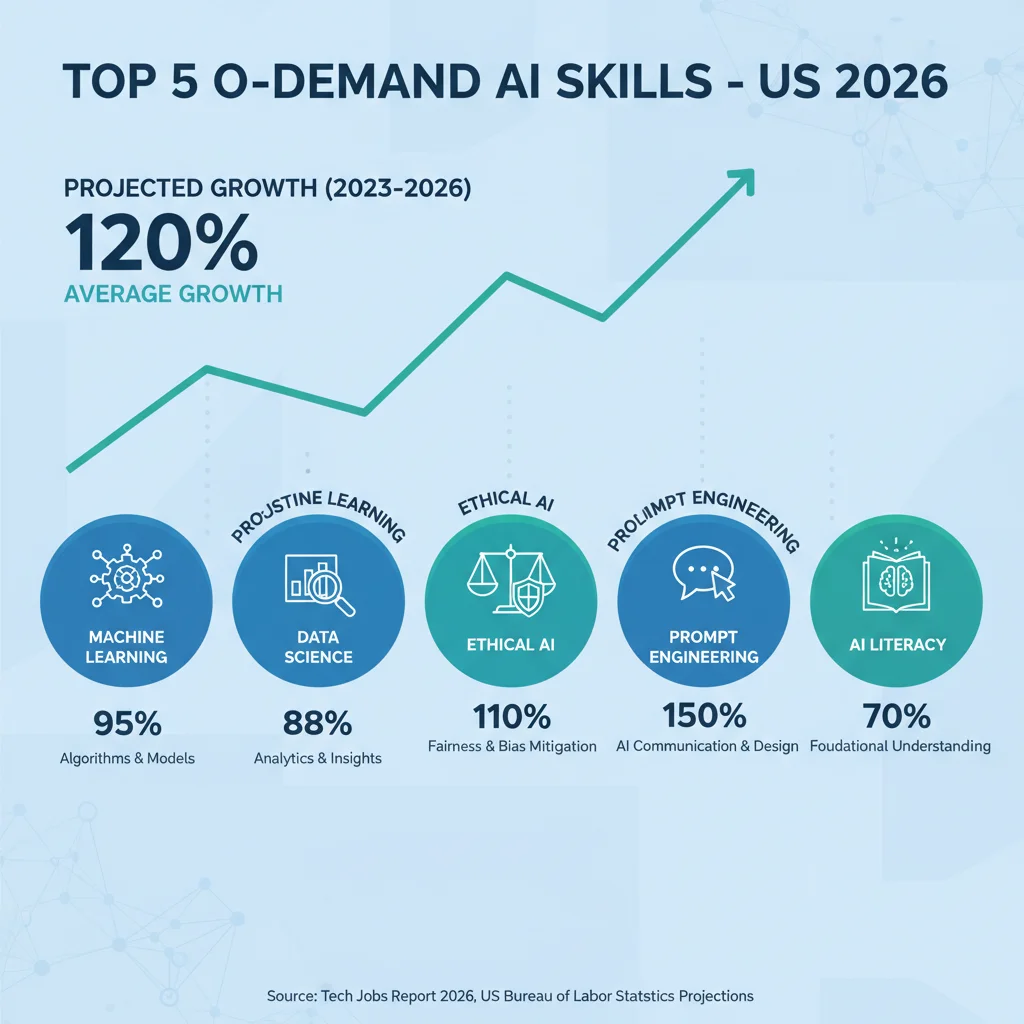
To stay competitive and relevant in the evolving US job market, professionals must identify and cultivate specific AI-related skills. By 2026, certain competencies will be indispensable across a wide array of sectors. Here are some of the most critical skills to focus on:
1. Machine Learning (ML) Fundamentals and Application
Understanding the basics of machine learning algorithms, including supervised, unsupervised, and reinforcement learning, is becoming increasingly important. This doesn’t necessarily mean becoming an ML engineer, but rather understanding how ML models work, how they are trained, and how their outputs can be interpreted and applied in business contexts. Professionals in data analysis, product management, and even marketing will benefit from this foundational knowledge. The ability to identify opportunities for ML implementation and to critically evaluate ML solutions will be a significant asset.
2. Data Science and Analytics
AI is built on data. Consequently, skills in data collection, cleaning, analysis, and interpretation are more crucial than ever. This includes proficiency in statistical analysis, data visualization, and using tools like Python (with libraries like Pandas, NumPy, Scikit-learn) or R. Professionals who can translate complex data into actionable insights, identify trends, and inform strategic decisions using AI-driven tools will be highly sought after. This extends beyond traditional data science roles to anyone who works with significant datasets.
3. AI Literacy and Ethical AI Principles
Beyond technical proficiency, a fundamental understanding of what AI is, its capabilities, limitations, and ethical implications is vital for everyone. AI literacy involves recognizing when and how AI can be used effectively, understanding its potential biases, and being able to engage in informed discussions about its societal impact. Ethical AI principles, such as fairness, transparency, accountability, and privacy, are gaining immense importance. Companies are increasingly looking for professionals who can ensure that AI systems are developed and deployed responsibly, mitigating risks and fostering trust.
4. Prompt Engineering and AI Interaction
With the rise of large language models (LLMs) and generative AI, the ability to effectively communicate with AI systems – known as prompt engineering – has emerged as a surprisingly critical skill. This involves crafting precise, clear, and context-rich prompts to elicit desired outputs from AI tools like ChatGPT, DALL-E, or Midjourney. Professionals who can master this interaction can significantly enhance their productivity, creativity, and problem-solving capabilities across various domains, from content creation to coding and strategic planning.
5. Cloud Computing and MLOps
Many AI applications are developed and deployed in cloud environments. Therefore, familiarity with major cloud platforms (AWS, Azure, Google Cloud) and their AI/ML services is becoming a valuable asset. MLOps (Machine Learning Operations) focuses on the practices and technologies for deploying and maintaining machine learning systems in production reliably and efficiently. While often a specialized role, a basic understanding of MLOps principles helps professionals appreciate the lifecycle of AI models and contribute to their successful implementation.
6. Domain Expertise + AI Application
Perhaps one of the most powerful combinations is deep domain expertise coupled with the ability to apply AI tools and methodologies within that specific field. For instance, a healthcare professional who understands how AI can improve diagnostics, a legal expert who leverages AI for case research, or a marketing specialist who uses AI for personalized campaigns. This synergy allows for innovative problem-solving and creates immense value.
Resources for AI Skill Development in the US
The good news is that there are abundant resources available for individuals and organizations committed to AI skill development. The US market, in particular, offers a wealth of options, ranging from formal education to self-paced online learning.
Online Learning Platforms and MOOCs
Massive Open Online Courses (MOOCs) and specialized platforms have democratized access to high-quality AI education. These platforms offer flexibility and a wide range of courses suitable for different skill levels and career goals:
- Coursera: Offers specializations and professional certificates from top universities and companies in AI, ML, data science, and deep learning. Notable courses include Andrew Ng’s ‘Machine Learning’ and ‘Deep Learning Specialization’.
- edX: Similar to Coursera, edX provides university-level courses and programs, often with a focus on practical application. They have numerous AI and data science tracks.
- Udemy: Known for its vast library of courses taught by industry experts, Udemy offers practical, project-based learning in areas like Python for AI, TensorFlow, PyTorch, and prompt engineering.
- Pluralsight: Specializes in technology skills training, offering learning paths for various AI and ML roles, from beginner to advanced.
- DataCamp: Focuses specifically on data science and analytics, with interactive courses and coding challenges that are excellent for building practical skills.
University Programs and Bootcamps
For those seeking more structured or intensive learning experiences, traditional university programs and specialized bootcamps are excellent options:
- Master’s Degrees: Many US universities now offer Master’s programs in Artificial Intelligence, Machine Learning, Data Science, and Computer Science with AI specializations. These provide a deep theoretical foundation and research opportunities.
- Graduate Certificates: Shorter than a full master’s, graduate certificates offer focused training in specific AI domains, often suitable for working professionals.
- Coding Bootcamps: Intensive, short-term programs designed to equip students with job-ready skills in areas like data science, machine learning engineering, and AI development. Examples include General Assembly, Flatiron School, and Springboard.
Industry Certifications
Certifications from leading technology companies can validate your skills and enhance your resume:
- Google Cloud Certifications: Offer various certifications related to AI and Machine Learning, such as the Professional Machine Learning Engineer.
- AWS Certifications: Amazon Web Services provides certifications like the AWS Certified Machine Learning – Specialty, demonstrating proficiency in building, training, and deploying ML models on AWS.
- Microsoft Azure Certifications: Microsoft offers certifications like Azure AI Engineer Associate, focusing on developing and implementing AI solutions on Azure.
Professional Organizations and Communities
Networking and continuous learning are vital. Joining professional organizations and online communities can provide access to mentors, job opportunities, and cutting-edge information:
- AI/ML Meetup Groups: Local and online communities where professionals share knowledge, discuss projects, and collaborate.
- Kaggle: A platform for data science and machine learning competitions, offering datasets, code sharing, and a vibrant community for learning and practice.
- Towards Data Science (Medium): A leading publication on Medium for articles, tutorials, and insights into AI, ML, and data science.
- LinkedIn Learning: Offers a vast library of courses, often bundled with LinkedIn Premium, covering various technical and soft skills related to AI.

Strategies for Effective AI Skill Development
Simply knowing what skills to acquire isn’t enough; having an effective strategy for AI skill development is crucial for success. Here are actionable steps to consider:
1. Assess Your Current Skill Set and Career Goals
Before diving into new learning, take stock of your existing skills. What are your strengths? What areas need improvement? More importantly, define your career goals for 2026 and beyond. Are you aiming for a specialized AI role, or do you want to integrate AI into your current profession? This self-assessment will help you prioritize learning paths.
2. Adopt a Growth Mindset and Embrace Lifelong Learning
The pace of technological change means that learning is no longer a finite process. A growth mindset, characterized by the belief that abilities can be developed through dedication and hard work, is essential. Embrace curiosity, be open to new ideas, and commit to continuous learning throughout your career. This is perhaps the most critical ‘soft skill’ for the AI era.
3. Focus on Practical Application and Projects
Theoretical knowledge is valuable, but practical application solidifies learning. Work on personal projects, participate in hackathons, or contribute to open-source AI initiatives. Building a portfolio of projects demonstrates your skills to potential employers and provides invaluable hands-on experience. Even small projects, like building a simple chatbot or analyzing a public dataset with ML, can be highly beneficial.
4. Network with AI Professionals and Join Communities
Connect with others in the AI field. Attend webinars, virtual conferences, and local meetups. Engaging with a community provides opportunities for mentorship, collaboration, and staying updated on the latest trends and tools. Networking can also open doors to new career opportunities and insights.
5. Develop Both Technical and Soft Skills
While technical AI skills are paramount, don’t neglect the importance of soft skills. As AI automates technical tasks, uniquely human skills like critical thinking, creativity, communication, collaboration, adaptability, and emotional intelligence become even more critical. These are the skills that enable you to leverage AI effectively and work alongside intelligent systems.
6. Understand the Business Context of AI
Technical AI skills are most impactful when applied within a business context. Understand how AI can solve real-world problems, drive business value, and create competitive advantages. This involves developing a strategic perspective on AI and being able to communicate its benefits and limitations to non-technical stakeholders.
The Role of Organizations in Fostering AI Skill Development
It’s not just individuals who need to adapt; organizations also play a crucial role in fostering AI skill development among their workforce. Companies that invest in upskilling and reskilling programs will be better positioned to harness the power of AI and maintain a competitive edge.
1. Invest in Training and Development Programs
Companies should proactively create and fund internal training programs or partner with external providers to offer AI and data science courses. This includes offering subsidies for certifications, university courses, and access to online learning platforms. Making learning accessible and incentivized is key.
2. Create a Culture of Continuous Learning
Beyond formal training, organizations need to cultivate an environment where continuous learning is encouraged and rewarded. This can involve dedicated learning days, internal knowledge-sharing sessions, and recognizing employees who acquire new skills. A culture that values adaptability will thrive in the AI era.
3. Implement AI-Powered Learning Tools
Leverage AI itself to personalize learning experiences for employees. AI-driven learning platforms can identify skill gaps, recommend relevant courses, and provide adaptive content, making AI skill development more efficient and engaging.
4. Promote Cross-Functional Collaboration
Encourage teams from different departments to collaborate on AI projects. This not only fosters a deeper understanding of AI’s applications across the organization but also helps in identifying new opportunities and challenges that AI can address. It also helps bridge the gap between technical AI experts and domain specialists.
5. Develop an AI Ethics Framework
As organizations integrate more AI, establishing clear ethical guidelines and training employees on responsible AI practices is paramount. This ensures that AI deployments are fair, transparent, and align with societal values, building trust among customers and employees.
The Future is Now: Preparing for 2026 and Beyond
The year 2026 might seem distant, but in the context of technological advancement, it’s just around the corner. The decisions and investments made today in AI skill development will significantly determine individual career trajectories and organizational success in the US market. The shift brought about by AI is not a temporary trend but a fundamental recalibration of the skills economy. Those who embrace this change with proactive learning and strategic planning will emerge as leaders and innovators.
The journey of skill development in the age of AI is continuous. It requires diligence, adaptability, and a willingness to step outside one’s comfort zone. However, the rewards – enhanced career opportunities, increased productivity, and the ability to contribute to groundbreaking innovations – are immense. By focusing on the key skills discussed, utilizing the myriad of available resources, and adopting effective learning strategies, professionals in the US can confidently navigate the AI revolution and shape a prosperous future.
Embrace the challenge, seize the opportunities, and embark on your journey of AI skill development today. The future of work is not something that happens to us; it is something we actively create through our commitment to learning and growth.