Navigating 2026 Supply Chain: Critical Insights for U.S. Businesses

The global economy is a dynamic entity, constantly reshaped by geopolitical shifts, technological advancements, and evolving consumer demands. For U.S. businesses, the supply chain is no longer just a functional necessity; it’s a strategic differentiator, a source of competitive advantage, and a potential vulnerability. As we look towards 2026, the landscape of the U.S. supply chain is poised for significant transformation. Understanding these shifts and proactively adapting to them will be paramount for sustained success and growth.
The past few years have been a crucible for supply chains worldwide. From the initial shocks of the pandemic to ongoing geopolitical tensions, labor shortages, and inflationary pressures, businesses have been forced to confront the fragility of their established networks. These challenges have, however, also catalyzed innovation and a renewed focus on building more resilient, efficient, and sustainable supply chain models. This blog post delves into three critical industry insights that U.S. businesses must internalize and act upon to navigate the new supply chain realities in 2026 and beyond. Our focus here is on providing actionable intelligence that can help you not just survive, but thrive, in this complex environment.
Insight 1: The Imperative of Hyper-Resilience and Redundancy in the U.S. Supply Chain 2026
One of the most profound lessons learned from recent global disruptions is the absolute necessity of resilience. For U.S. businesses, relying on single-source suppliers or lengthy, brittle supply lines is a risk that can no longer be tolerated. The year 2026 will see an intensified focus on building ‘hyper-resilient’ supply chains – systems designed not just to withstand shocks, but to adapt, recover, and even grow stronger in their wake.
Diversification of Sourcing and Manufacturing
The move away from over-reliance on a single geographic region or supplier is a cornerstone of hyper-resilience. This means actively exploring and establishing relationships with multiple suppliers across different geographies, including nearshoring and reshoring initiatives. Nearshoring, bringing production closer to the U.S. market (e.g., Mexico, Canada), offers advantages in reduced lead times, lower transportation costs, and better control over quality and labor practices. Reshoring, bringing manufacturing back to the U.S., while often more expensive initially, offers unparalleled supply security, reduced geopolitical risk, and the ability to leverage advanced manufacturing techniques.
For example, a U.S. electronics manufacturer might have traditionally sourced critical components exclusively from East Asia. In a hyper-resilient model for 2026, they would diversify their sourcing to include suppliers in Europe, Latin America, and potentially even domestic manufacturers for high-priority components. This multi-pronged approach mitigates the risk of a single point of failure due to natural disasters, trade disputes, or factory shutdowns in one region.
Building Buffer Stocks and Strategic Inventories
The lean manufacturing philosophy, while efficient in stable times, proved vulnerable during periods of extreme demand fluctuation and supply constriction. While excessive inventory ties up capital, 2026 will see a re-evaluation of optimal inventory levels. Businesses will strategically increase buffer stocks for critical components and finished goods, especially those with long lead times or high demand volatility. This isn’t about hoarding; it’s about intelligent inventory management, leveraging data analytics to predict potential disruptions and pre-position inventory accordingly.
Consider a U.S. automotive parts distributor. Instead of relying solely on just-in-time delivery, they might establish strategically located regional warehouses holding safety stock for high-demand, critical parts. This ensures that even if a primary shipping route is disrupted or a supplier faces production delays, they can still fulfill customer orders, minimizing downtime for their clients.
Geopolitical Risk Assessment and Scenario Planning
The geopolitical landscape is increasingly volatile. Trade wars, sanctions, political instability, and even cyber warfare can have immediate and severe impacts on global supply chains. U.S. businesses must integrate robust geopolitical risk assessment into their supply chain planning. This involves identifying potential flashpoints, understanding their likely impact on specific nodes of their supply chain, and developing comprehensive scenario plans.
What if a major shipping lane is temporarily closed? What if new tariffs are imposed on goods from a key manufacturing country? What if a critical raw material becomes subject to export restrictions? By asking these questions and developing contingency plans – such as identifying alternative shipping routes, pre-negotiating with alternative suppliers, or even redesigning products to use different materials – businesses can significantly enhance their ability to respond effectively when such events occur. This forward-looking approach is vital for the U.S. Supply Chain 2026.
Investing in Supply Chain Visibility and Traceability
You can’t manage what you can’t see. Hyper-resilience demands end-to-end visibility across the entire supply chain, from raw material extraction to final delivery. This includes knowing not just your direct suppliers, but your suppliers’ suppliers (N-tier visibility). Technologies like blockchain, IoT sensors, and advanced analytics platforms are becoming indispensable for achieving this level of transparency. Traceability allows businesses to quickly identify the source of a disruption, assess its impact, and pivot to alternative solutions.
For a U.S. food producer, achieving N-tier visibility means being able to track ingredients back to their farms of origin. If a contamination issue arises, they can quickly pinpoint the source, initiate targeted recalls if necessary, and reassure consumers, thereby protecting brand reputation and minimizing financial losses.
Insight 2: Digital Transformation and AI as the Engine of U.S. Supply Chain 2026 Efficiency
The digital revolution has been underway for decades, but its impact on supply chains is accelerating exponentially. In 2026, artificial intelligence (AI), machine learning (ML), and advanced automation will no longer be luxuries but foundational elements for achieving operational excellence and competitive advantage in the U.S. Supply Chain 2026. Businesses that fail to embrace these technologies risk being left behind.
AI-Powered Demand Forecasting and Predictive Analytics
Traditional demand forecasting methods often struggle with volatility and unexpected market shifts. AI and ML algorithms, however, can analyze vast datasets – including historical sales, weather patterns, social media trends, economic indicators, and even real-time news feeds – to generate far more accurate demand predictions. This allows businesses to optimize inventory levels, production schedules, and logistics planning, reducing waste and improving customer satisfaction.
A U.S. retail chain, for instance, can leverage AI to predict demand for seasonal clothing items with unprecedented accuracy. This enables them to order the right quantities, at the right time, minimizing overstocking (which leads to markdowns) and understocking (which leads to lost sales). The predictive power of AI is a game-changer for inventory optimization.
Automation in Warehousing and Logistics
From robotic process automation (RPA) in administrative tasks to autonomous guided vehicles (AGVs) and collaborative robots (cobots) in warehouses, automation is transforming physical logistics. These technologies increase efficiency, reduce labor costs, improve accuracy, and enhance safety. In light of ongoing labor shortages and rising wage costs in the U.S., automation offers a compelling solution to maintain operational continuity and cost-effectiveness.

Consider a large U.S. e-commerce fulfillment center. AGVs can transport goods between receiving, storage, and packing stations, while robotic arms can pick and place items with high precision and speed. This not only accelerates order fulfillment but also allows human workers to focus on more complex, value-added tasks, addressing the challenges of the U.S. Supply Chain 2026 labor market.
Blockchain for Enhanced Transparency and Security
Blockchain technology, while still maturing, holds immense promise for supply chain management. Its distributed, immutable ledger system can provide unparalleled transparency and traceability for goods, from their origin to the consumer. This is particularly valuable for industries where authenticity, ethical sourcing, or regulatory compliance are critical, such as pharmaceuticals, food, and luxury goods.
For a U.S. pharmaceutical company, blockchain can track each batch of medication through its entire journey, verifying its origin, storage conditions, and handling. This not only combats counterfeiting but also ensures compliance with stringent regulations, offering peace of mind to both regulators and patients. This level of secure data sharing is crucial for building trust in the U.S. Supply Chain 2026.
Digital Twins and Supply Chain Control Towers
A digital twin is a virtual replica of a physical system, process, or product. In the context of supply chains, a digital twin can simulate the entire network, allowing businesses to test different scenarios (e.g., supplier disruption, demand surge) without impacting real-world operations. Coupled with a ‘supply chain control tower’ – a centralized hub that aggregates real-time data from across the network – businesses gain unprecedented visibility and control.
A U.S. logistics provider could use a digital twin to model the impact of a severe weather event on their trucking routes. By running simulations, they can identify alternative routes, reallocate resources, and proactively communicate with customers, minimizing delays and maintaining service levels. The control tower then provides the real-time data to execute these plans effectively, making the U.S. Supply Chain 2026 more responsive.
Insight 3: Sustainability as a Core Driver of U.S. Supply Chain 2026 Strategy
Environmental, Social, and Governance (ESG) factors are no longer peripheral concerns; they are increasingly central to business strategy, investor decisions, and consumer preferences. For U.S. businesses, integrating sustainability into supply chain operations is not just about corporate responsibility; it’s a critical driver of efficiency, cost reduction, risk mitigation, and brand reputation in 2026 and beyond.
Embracing Circular Economy Principles
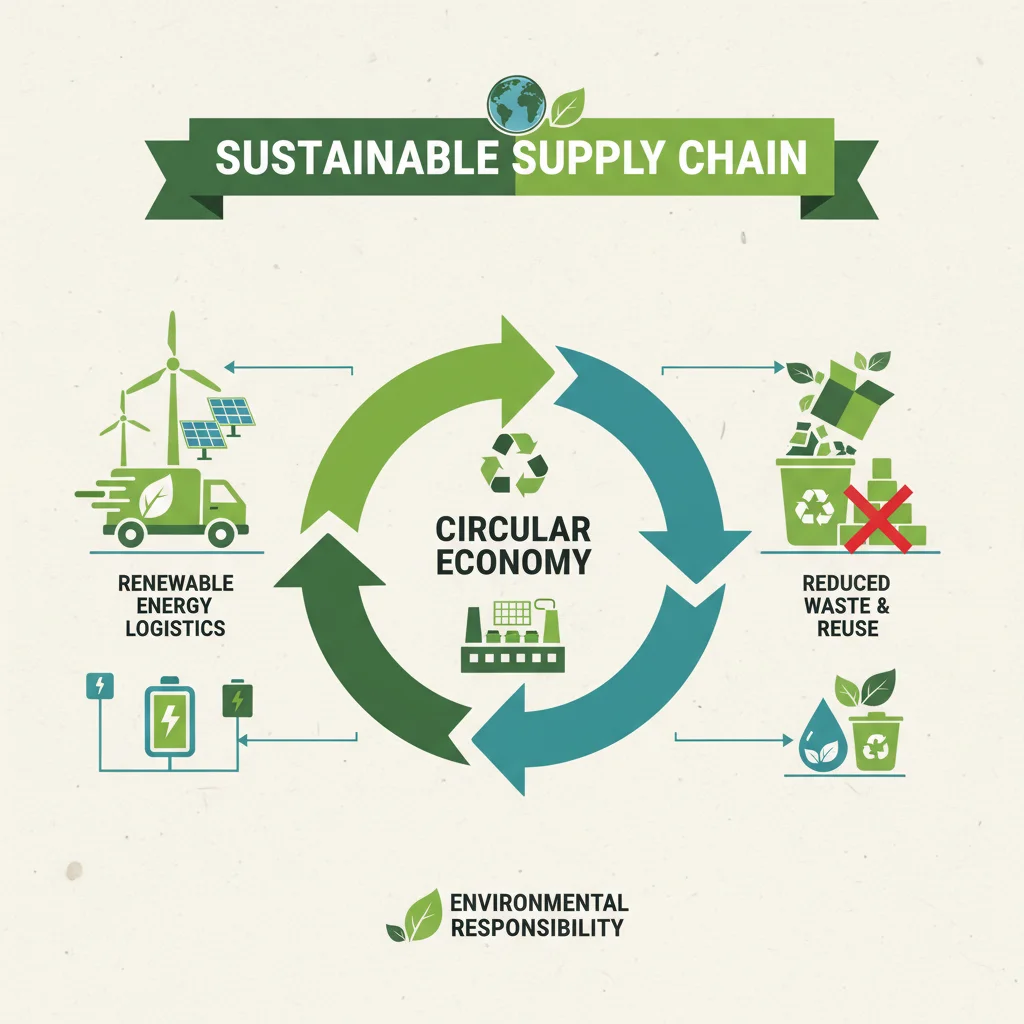
The traditional linear ‘take-make-dispose’ model is unsustainable. The circular economy, which focuses on designing out waste and pollution, keeping products and materials in use, and regenerating natural systems, is gaining significant traction. For supply chains, this means optimizing for repair, reuse, remanufacturing, and recycling of products and materials. It requires rethinking product design, logistics, and reverse logistics networks.
A U.S. appliance manufacturer could design their products for easy disassembly and repair, offering take-back programs for end-of-life appliances. Components can then be reused or recycled into new products, significantly reducing waste and the reliance on virgin materials. This not only reduces environmental impact but can also unlock new revenue streams and improve resource efficiency within the U.S. Supply Chain 2026.
Reducing Carbon Footprint in Logistics and Transportation
Transportation is a major contributor to greenhouse gas emissions within supply chains. U.S. businesses must actively pursue strategies to reduce their carbon footprint. This includes optimizing shipping routes to minimize mileage, shifting to more fuel-efficient modes of transport (e.g., rail over road where feasible), investing in electric or hydrogen-powered vehicle fleets, and exploring alternative fuels.
A U.S. food distributor might consolidate shipments, optimize delivery routes using advanced software, and gradually transition its fleet to electric vehicles. They could also explore partnerships with logistics providers that prioritize sustainable practices, such as using biofuels or having carbon-neutral shipping options. These efforts contribute directly to a greener U.S. Supply Chain 2026.
Ethical Sourcing and Labor Practices
Consumers and regulators are increasingly demanding transparency and ethical conduct throughout the supply chain. This means ensuring that suppliers adhere to fair labor practices, respect human rights, and operate without exploiting child labor or engaging in other unethical behaviors. Auditing supplier practices, establishing clear codes of conduct, and leveraging blockchain for ethical traceability are becoming standard practices.
A U.S. apparel brand, for instance, must go beyond simply checking boxes. They need to engage deeply with their overseas manufacturers, conduct regular independent audits, and potentially invest in programs that support worker welfare and skill development. This builds trust with consumers and mitigates reputational risks, crucial for the ethically conscious U.S. Supply Chain 2026.
Sustainable Packaging Innovations
Packaging waste is a significant environmental concern. U.S. businesses are under pressure to adopt more sustainable packaging solutions. This includes reducing packaging materials, using recycled and recyclable content, exploring biodegradable or compostable options, and designing packaging for reuse.
An e-commerce company could switch from plastic bubble wrap to recycled paper-based cushioning, use smaller, right-sized boxes to reduce void fill, and offer customers options for package-free delivery where feasible. These innovations not only reduce environmental impact but can also lead to cost savings in materials and transportation, making the U.S. Supply Chain 2026 more efficient and eco-friendly.
The Path Forward: Integrating Insights for a Robust U.S. Supply Chain 2026
The three critical insights – hyper-resilience, digital transformation, and sustainability – are not isolated concepts. They are interconnected and mutually reinforcing. A resilient supply chain often leverages digital tools for visibility and predictive analytics. Sustainable practices can lead to greater efficiency and cost savings, contributing to overall resilience. Digital transformation can enable better tracking of ethical sourcing and carbon footprint.
Strategic Investment in Technology and Talent
Implementing these insights requires significant investment – not just in technology, but also in the talent needed to manage and leverage these new systems. U.S. businesses must prioritize upskilling their workforce in areas like data analytics, AI operations, and sustainable supply chain management. Attracting and retaining talent with these specialized skills will be a key competitive advantage.
Collaboration Across the Ecosystem
No single company operates in isolation. Building a robust U.S. Supply Chain 2026 requires collaboration across the entire ecosystem – with suppliers, logistics partners, technology providers, and even competitors. Sharing data, co-developing solutions, and establishing industry best practices will accelerate the transition to more efficient and resilient networks.
Agile and Adaptive Planning
The future is inherently uncertain. While predictive analytics can offer valuable foresight, businesses must also cultivate an agile mindset. This involves continuous monitoring of global events, regular review of supply chain strategies, and the ability to pivot quickly in response to unforeseen challenges. Scenario planning should be an ongoing process, not a one-off exercise.
Conclusion: Shaping the Future of the U.S. Supply Chain
The year 2026 presents both challenges and unparalleled opportunities for U.S. businesses in the realm of supply chain management. By proactively embracing hyper-resilience, leveraging the power of digital transformation and AI, and embedding sustainability into their core strategies, companies can build supply chains that are not only robust and efficient but also ethically sound and environmentally responsible. The journey ahead demands foresight, strategic investment, and a commitment to continuous adaptation. Those who successfully navigate these new realities will secure a significant competitive edge, driving growth and ensuring long-term success in an ever-evolving global marketplace. The future of the U.S. Supply Chain 2026 is being shaped now, and the time for action is upon us.