2026 Corporate Training Trends: U.S. Online Learning Platforms

The year 2026 is rapidly approaching, and with it, a significant transformation in how U.S. companies approach corporate training. The shift towards online learning platforms is no longer a trend but a foundational element of strategic workforce development. As businesses navigate an increasingly complex global economy, technological advancements, and evolving employee expectations, the emphasis on robust, flexible, and impactful corporate training platforms has never been more critical. This article will delve into the core priorities for U.S. companies in 2026, examining what drives their investment in online learning and how these platforms are being leveraged to build future-ready workforces.
The pandemic acted as a catalyst, accelerating the adoption of digital learning solutions by years. Now, as we look towards 2026, companies are not just seeking alternatives to in-person training; they are demanding sophisticated, integrated, and data-driven corporate training platforms that can address a myriad of organizational needs. The focus has sharpened on measurable outcomes, personalized learning experiences, and scalability, all delivered through innovative online environments. Understanding these priorities is key for both organizations seeking to optimize their L&D strategies and providers developing the next generation of learning solutions.
The Imperative for Agile Skill Development
One of the foremost priorities for U.S. companies in 2026 is the urgent need for agile skill development. The pace of technological change means that skills can become obsolete faster than ever before. Automation, artificial intelligence, and new digital tools are constantly reshaping job roles and demanding new competencies. Therefore, businesses are prioritizing corporate training platforms that can rapidly deploy and update learning content to address emerging skill gaps.
This agility extends beyond just technical skills. Soft skills, such as critical thinking, adaptability, emotional intelligence, and complex problem-solving, are increasingly recognized as essential for navigating dynamic work environments. Online platforms offer the flexibility to integrate these diverse learning paths, often through blended learning approaches that combine self-paced modules with virtual instructor-led sessions and collaborative projects. Companies are looking for platforms that can not only identify these skill gaps but also provide tailored learning journeys to close them efficiently.
Personalized Learning Paths: The New Standard
Gone are the days of one-size-fits-all training. In 2026, U.S. companies are heavily prioritizing personalized learning paths within their corporate training platforms. Employees come with varying levels of existing knowledge, different learning styles, and diverse career aspirations. A personalized approach ensures that training is relevant, engaging, and maximizes individual growth.
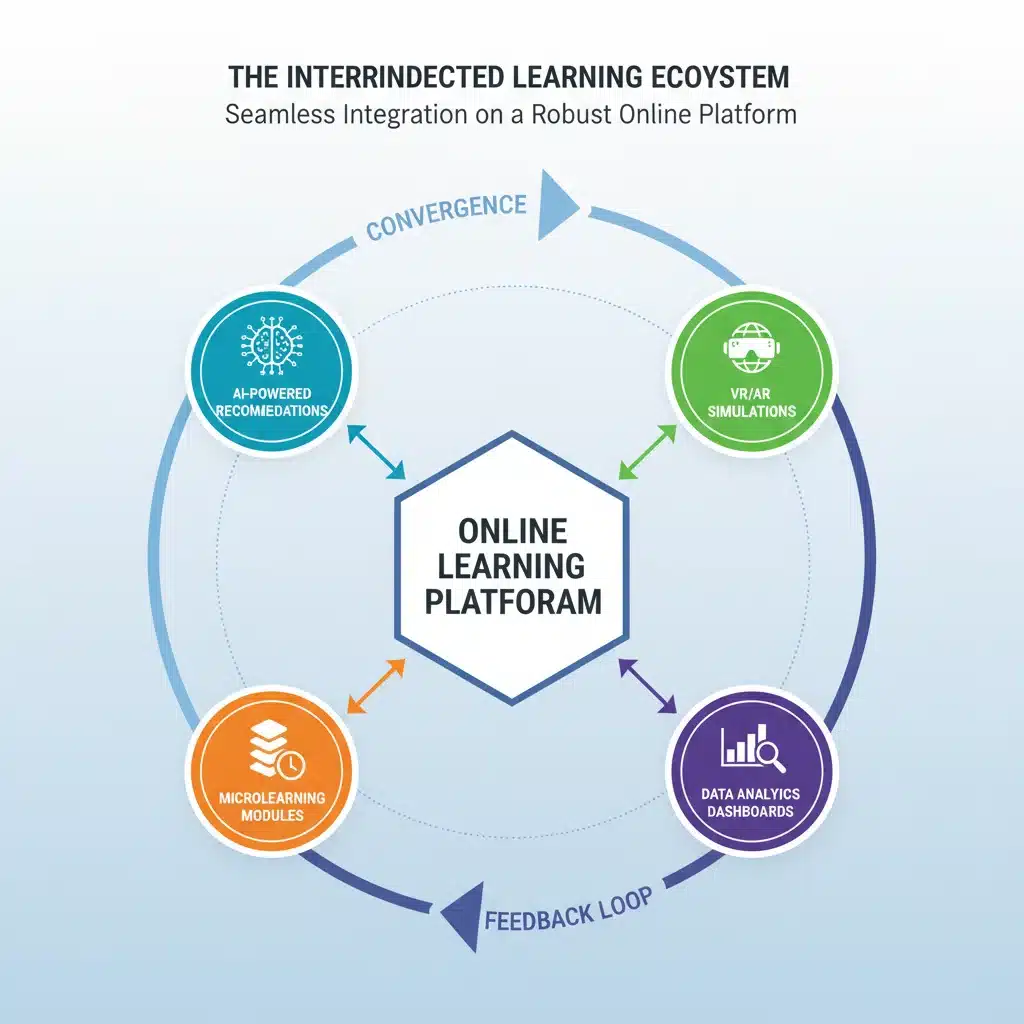
This personalization is largely driven by advanced analytics and artificial intelligence. AI-powered platforms can assess an individual’s current skills, identify areas for improvement, and recommend specific courses, modules, or resources. This creates a highly efficient learning experience, preventing learners from wasting time on content they already know and focusing their efforts where it will have the most impact. The goal is to make learning feel less like a mandatory chore and more like a tailored career development opportunity, boosting engagement and retention of knowledge.
Integration with Business Systems and Data Analytics
For corporate training platforms to be truly effective in 2026, seamless integration with existing business systems is non-negotiable. Companies need their learning management systems (LMS) or learning experience platforms (LXP) to connect with HRIS (Human Resources Information Systems), performance management tools, and talent management suites. This integration allows for a holistic view of employee development, linking learning outcomes directly to performance reviews, career progression, and overall business objectives.
Furthermore, robust data analytics capabilities are a top priority. Organizations want to move beyond simple completion rates and understand the true impact of their training investments. This means tracking metrics such as skill acquisition, application of new knowledge on the job, improved productivity, and reduced errors. Advanced analytics dashboards help L&D professionals identify effective programs, pinpoint areas for improvement, and demonstrate the ROI of their corporate training platforms to stakeholders. This data-driven approach ensures that learning initiatives are continually optimized and aligned with strategic business goals.
Microlearning and On-Demand Content
In a fast-paced work environment, employees often struggle to dedicate long blocks of time to training. This reality has propelled microlearning and on-demand content to the forefront of priorities for corporate training platforms in 2026. Microlearning involves delivering content in short, digestible chunks – typically 3-10 minutes – that can be consumed quickly and conveniently, often during brief breaks or between tasks.
The emphasis is on accessibility and immediate applicability. Employees need to be able to access relevant information precisely when they need it, whether it’s a quick tutorial on a new software feature or a refresher on a compliance policy. Online learning platforms that excel in organizing and delivering a vast library of microlearning modules, easily searchable and accessible via various devices, are highly valued. This approach supports continuous learning and ensures that knowledge is always at an employee’s fingertips.
Experiential Learning and Simulations
While theoretical knowledge is important, U.S. companies in 2026 are increasingly prioritizing experiential learning and simulations within their corporate training platforms. The aim is to bridge the gap between learning and doing, allowing employees to practice new skills in a safe, controlled environment before applying them in real-world scenarios. This is particularly crucial for complex or high-stakes roles.
Technologies like virtual reality (VR), augmented reality (AR), and sophisticated interactive simulations are becoming more commonplace. For instance, VR can be used for realistic safety training, customer service role-playing, or complex machinery operation. AR can overlay digital information onto the real world, assisting with on-the-job guidance. These immersive experiences significantly enhance engagement, improve knowledge retention, and build confidence, making them invaluable components of modern corporate training platforms.
Focus on Upskilling and Reskilling for Future Readiness
The concept of a ‘future-ready workforce’ is a dominant theme driving investment in corporate training platforms for 2026. With economic shifts and technological disruption, companies recognize the critical need to upskill their current employees for new roles and reskill them for entirely different career paths within the organization. This proactive approach not only addresses potential talent shortages but also fosters employee loyalty and reduces recruitment costs.
Online learning platforms are central to these upskilling and reskilling initiatives. They provide the necessary infrastructure to deliver comprehensive curricula, track progress across multiple competencies, and certify new skills. Companies are looking for platforms that can offer curated pathways for specific career transitions, integrating assessments, mentorship opportunities, and project-based learning to ensure practical application of new capabilities. The ability to quickly adapt and deploy new training programs is paramount to staying competitive.
Enhanced Collaboration and Social Learning Features
Learning is often a social process, and corporate training platforms in 2026 are increasingly incorporating enhanced collaboration and social learning features. While self-paced modules are valuable, opportunities for peer-to-peer interaction, group projects, and discussions can significantly deepen understanding and foster a sense of community among learners.
Companies are seeking platforms that offer integrated discussion forums, virtual classrooms, collaborative workspaces, and even peer-review functionalities. These features allow employees to share insights, ask questions, learn from each other’s experiences, and build networks. This not only enriches the learning experience but also promotes a culture of continuous learning and knowledge sharing within the organization. The best corporate training platforms facilitate both individual growth and collective intelligence.
Accessibility and Inclusivity
As workforces become more diverse and distributed, accessibility and inclusivity are paramount considerations for corporate training platforms in 2026. Companies are committed to ensuring that all employees, regardless of their location, physical abilities, or technological proficiency, have equal access to learning opportunities.
This means prioritizing platforms that adhere to accessibility standards (e.g., WCAG), offer multi-language support, provide options for different learning speeds, and are compatible with a wide range of devices and internet connections. An inclusive platform fosters a sense of belonging and ensures that no employee is left behind in their professional development. The focus is on removing barriers to learning and creating an equitable educational experience for everyone.
Security and Compliance
With increasing cyber threats and stringent data privacy regulations (like GDPR and various state-level privacy laws in the U.S.), the security and compliance features of corporate training platforms are a top priority for 2026. Companies handle sensitive employee data and often train on confidential business processes, making robust security measures absolutely essential.
Organizations are scrutinizing platforms for features such as data encryption, secure login protocols (e.g., multi-factor authentication), regular security audits, and compliance with industry-specific regulations. Furthermore, platforms must be capable of tracking and reporting on compliance training, providing audit trails and certification management to ensure regulatory adherence. A breach in a learning platform can have severe consequences, so trust and reliability are non-negotiable.
Mobile-First Design and Flexibility
The modern workforce is highly mobile, and employees expect to be able to learn on their own terms, whenever and wherever it’s convenient. This has led to a strong prioritization of mobile-first design and overall flexibility in corporate training platforms for 2026. Employees are often juggling work, personal commitments, and professional development, so the ability to access training content on smartphones or tablets during commutes, breaks, or off-hours is crucial.
A truly mobile-first platform offers a seamless user experience across devices, with responsive design, intuitive navigation, and content optimized for smaller screens. This flexibility extends to offline access capabilities, allowing employees to download modules and complete them without an internet connection, syncing their progress later. Such adaptability significantly boosts engagement and ensures that learning can fit into the rhythm of an employee’s life, rather than disrupting it.
The Role of AI in Enhancing Learning Experiences
Artificial intelligence is not just a buzzword; it’s a transformative force in corporate training platforms for 2026. Beyond personalized recommendations, AI is being leveraged in numerous ways to enhance the learning experience. AI-powered chatbots can act as virtual tutors, answering questions, providing instant feedback, and guiding learners through content. This ‘always-on’ support can significantly improve comprehension and reduce the burden on human instructors.
Moreover, AI is being used for adaptive learning, where the platform adjusts the difficulty and type of content based on a learner’s real-time performance and understanding. If a learner struggles with a concept, the AI can provide additional resources or practice exercises. Conversely, if they demonstrate mastery, they can be fast-tracked to more advanced topics. AI also plays a role in content curation, automatically identifying and suggesting relevant external resources, articles, and videos to supplement formal training. This intelligent augmentation makes corporate training platforms far more dynamic and effective.
Measuring ROI and Impact
Ultimately, for U.S. companies in 2026, the success of corporate training platforms is measured by their return on investment (ROI) and tangible impact on business outcomes. L&D departments are under increasing pressure to demonstrate how training initiatives contribute directly to profitability, efficiency, employee retention, and innovation. This requires platforms that can provide sophisticated reporting and analytics beyond simple completion rates.
Companies are looking for functionalities that allow them to correlate training data with performance data, track skill application, measure behavioral changes, and ultimately link learning to key performance indicators (KPIs). This might involve pre- and post-training assessments, performance reviews that incorporate skill development, and even direct business metrics like sales figures, customer satisfaction scores, or project success rates. The ability to clearly articulate the value of learning is paramount, making robust measurement tools a top priority for any corporate training platform.

Sustainability and Ethical Considerations
As corporate social responsibility gains prominence, U.S. companies are also beginning to consider the sustainability and ethical implications of their corporate training platforms. This includes evaluating the environmental impact of cloud-based solutions (energy consumption of data centers), ensuring ethical AI practices (avoiding bias in algorithms), and promoting fair labor practices in content creation.
While perhaps not as immediate as skill development or ROI, these considerations are growing in importance, especially for larger corporations with strong ESG (Environmental, Social, and Governance) commitments. Platforms that can demonstrate a commitment to these values may gain a competitive edge as companies seek partners aligned with their broader corporate ethics. This holistic view extends beyond technical features to the very principles underpinning the learning ecosystem.
Conclusion: The Future-Focused Corporate Training Platform
The 2026 landscape for U.S. corporate training platforms is characterized by a relentless pursuit of efficiency, personalization, and measurable impact. Companies are moving beyond basic e-learning to embrace sophisticated, integrated solutions that leverage AI, data analytics, and immersive technologies to build agile and future-ready workforces. The priorities are clear: personalized learning paths, seamless integration with business systems, agile skill development, experiential learning, and a strong focus on demonstrating ROI.
For organizations, selecting the right corporate training platforms will be a strategic decision that directly impacts their ability to adapt, innovate, and thrive in the coming years. For providers, the challenge and opportunity lie in delivering solutions that not only meet these evolving demands but anticipate the next wave of learning innovation. The future of work is intrinsically linked to the future of learning, and in 2026, online platforms will be at the very heart of this critical connection, empowering employees and driving organizational success.