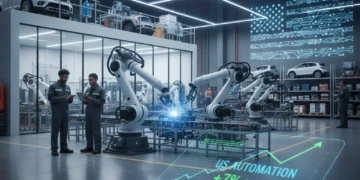
Emerging Technologies Driving 15% Growth in U.S. Tech Sector by Mid-2026: An Insider’s Look
The United States tech sector stands on the precipice of an unprecedented surge, with analysts projecting a robust 15% growth by mid-2026. This significant expansion isn’t merely a continuation of past trends; it’s a profound transformation driven by a constellation of emerging tech growth. From the intricate algorithms of artificial intelligence to the mind-bending possibilities of quantum computing and the decentralized promise of Web3, these innovations are not just incremental improvements but foundational shifts reshaping industries, economies, and daily life. For investors, entrepreneurs, and tech enthusiasts alike, understanding the forces at play is paramount to navigating this dynamic landscape and capitalizing on the opportunities it presents.
This article provides an insider’s perspective on the critical technologies fueling this projected growth, delving into their current impact and future potential. We will explore how these advancements are creating new markets, disrupting old ones, and redefining the very fabric of the U.S. economy. The narrative will highlight the interplay between these technologies, demonstrating how their synergistic evolution is accelerating the pace of innovation and opening doors to previously unimaginable possibilities. The focus will be on the tangible effects of emerging tech growth, illustrating how these breakthroughs translate into economic value, job creation, and enhanced productivity across various sectors.
The tech sector has always been a bellwether for economic dynamism, and its current trajectory signals a period of intense innovation and expansion. The 15% growth forecast is not a mere statistical projection; it reflects deep-seated shifts in technological capabilities and market demands. As we unravel the intricacies of this growth, we will uncover the strategic investments, research breakthroughs, and policy frameworks that are collectively paving the way for a vibrant and prosperous technological future. The insights presented here are designed to equip readers with a comprehensive understanding of the forces shaping tomorrow’s tech landscape, offering a roadmap for engagement and participation in this exciting era of emerging tech growth.
The Artificial Intelligence Revolution: A Catalyst for Unprecedented Growth
Artificial Intelligence (AI) is undeniably at the forefront of the emerging tech growth narrative. Its pervasive influence is transforming virtually every industry, from healthcare and finance to manufacturing and entertainment. The advancements in machine learning, deep learning, and natural language processing have propelled AI beyond theoretical concepts into practical applications that are driving significant economic value. Companies are leveraging AI to automate complex tasks, optimize supply chains, personalize customer experiences, and generate unprecedented insights from vast datasets. This widespread adoption is not just about efficiency; it’s about unlocking new frontiers of innovation and competitive advantage.
In the U.S. tech sector, AI’s impact is particularly pronounced in several key areas. Firstly, the development of sophisticated AI models and platforms is creating a burgeoning market for AI-as-a-Service (AIaaS), allowing businesses of all sizes to access powerful AI capabilities without extensive in-house expertise. This democratization of AI is accelerating its integration across diverse sectors. Secondly, AI is a critical enabler for other emerging tech growth areas, such as advanced robotics, autonomous systems, and personalized medicine. Its ability to process and interpret complex information at scale makes it an indispensable tool for pushing the boundaries of what’s possible.
The investment landscape in AI reflects its immense potential. Venture capital funding for AI startups continues to soar, signaling strong confidence in its future trajectory. Furthermore, major tech giants are pouring resources into AI research and development, leading to rapid breakthroughs and an ever-expanding ecosystem of AI-powered solutions. The ethical considerations and regulatory frameworks surrounding AI are also evolving, ensuring responsible development and deployment of these powerful technologies. As AI continues to mature, its role as a primary driver of the 15% U.S. tech sector growth will only intensify, making it a cornerstone of the modern digital economy. The ability of AI to learn, adapt, and make predictions is fundamentally changing how businesses operate, leading to significant gains in productivity and innovation. This sustained focus on AI is a clear indicator of its central role in future economic expansion and technological advancement.
Consider the healthcare sector, where AI is revolutionizing diagnostics, drug discovery, and personalized treatment plans. AI algorithms can analyze medical images with greater accuracy than human experts, identify subtle patterns in patient data that indicate disease progression, and even design novel drug compounds. In finance, AI-driven algorithms are used for fraud detection, algorithmic trading, and personalized financial advice, leading to more secure and efficient markets. The retail industry is leveraging AI for predictive analytics to forecast demand, optimize inventory, and create highly tailored shopping experiences for consumers. These examples barely scratch the surface of AI’s transformative power, illustrating why it’s a critical component of the projected emerging tech growth.

Quantum Computing: The Next Frontier of Computational Power
While still in its nascent stages, quantum computing represents perhaps the most revolutionary aspect of emerging tech growth. Unlike classical computers that store information as bits (0s or 1s), quantum computers use qubits, which can exist in multiple states simultaneously (superposition) and be intrinsically linked (entanglement). This fundamental difference allows quantum computers to perform calculations exponentially faster than even the most powerful supercomputers for certain types of problems. The implications for fields like cryptography, materials science, drug discovery, and complex optimization problems are staggering.
The U.S. is a global leader in quantum computing research and development, with significant investments from both government agencies and private companies. Major tech players are building quantum hardware, developing quantum algorithms, and creating quantum software ecosystems. While practical, fault-tolerant quantum computers are still some years away, the progress being made is rapid and substantial. Early-stage quantum devices are already demonstrating capabilities that hint at their future potential, particularly in specialized computational tasks that are intractable for classical machines.
The economic impact of quantum computing, though not immediate, is projected to be immense. It has the potential to unlock breakthroughs in areas like personalized medicine (by simulating molecular interactions with unprecedented accuracy), financial modeling (by optimizing complex portfolios), and artificial intelligence (by enabling more powerful machine learning algorithms). The race to develop stable and scalable quantum computers is intense, with nations and corporations vying for leadership in this critical emerging tech growth area. As quantum technology matures, it will undoubtedly contribute significantly to the U.S. tech sector’s growth, fundamentally altering the landscape of computation and problem-solving.
The long-term vision for quantum computing involves a paradigm shift in how we approach complex scientific and engineering challenges. Imagine simulating new materials at the atomic level to design lighter, stronger, or more conductive substances. Envision breaking currently unbreakable encryption methods, necessitating new standards of cybersecurity. Consider the ability to optimize logistics networks, drug trials, or financial models with a level of precision and speed currently impossible. These are not distant pipe dreams but the very applications driving the intense research and development in quantum computing today. The talent pool in quantum mechanics, computer science, and engineering is growing, fostering an ecosystem ripe for accelerated emerging tech growth in this sector.
Web3, Blockchain, and Decentralization: Reshaping the Digital Economy
Web3, often described as the next iteration of the internet, is built upon the foundational principles of decentralization, transparency, and user ownership, largely powered by blockchain technology. This paradigm shift from centralized platforms to distributed networks is creating a wave of emerging tech growth across various applications, including cryptocurrencies, Non-Fungible Tokens (NFTs), Decentralized Autonomous Organizations (DAOs), and a new generation of decentralized applications (dApps).
Blockchain, the underlying technology for Web3, offers immutable and transparent record-keeping, secure transactions, and smart contract functionality. These features are being leveraged to create more secure and efficient systems in finance, supply chain management, digital identity, and intellectual property. The U.S. tech sector is actively exploring and investing in Web3 infrastructure, with significant venture capital flowing into blockchain startups and decentralized finance (DeFi) projects. The promise of Web3 lies in its ability to empower users by giving them greater control over their data and digital assets, fostering a more equitable and open digital economy.
While still facing regulatory challenges and scalability hurdles, the long-term potential of Web3 to disrupt traditional internet models is undeniable. It’s fostering innovation in areas like digital ownership, creator economies, and new forms of online governance. As more developers and entrepreneurs build on Web3 platforms, its contribution to the overall 15% U.S. tech sector growth will become increasingly significant, ushering in an era of greater user empowerment and decentralized digital services. The shift towards a more transparent and user-centric internet is not just a technological evolution but a societal one, with profound implications for how we interact, transact, and create value online. This fundamental re-architecture of the internet is a powerful driver of emerging tech growth.
The impact of Web3 extends beyond just financial applications. Consider the potential for decentralized social media platforms that give users direct control over their data and content, free from the whims of a central authority. Think about supply chains where every step of a product’s journey is recorded on an immutable ledger, enhancing transparency and combating counterfeiting. Imagine digital identity solutions that empower individuals to control their personal information, sharing only what’s necessary, when necessary. These applications, still in their early stages, represent a massive untapped market and a significant source of future emerging tech growth, promising to redefine digital interactions and trust.
Other Key Drivers: Cloud Computing, Cybersecurity, and Advanced Connectivity
Beyond AI, quantum computing, and Web3, several other emerging tech growth areas are playing crucial roles in the U.S. tech sector’s expansion:
- Advanced Cloud Computing: The continuous evolution of cloud infrastructure, including edge computing and serverless architectures, is providing the scalable, flexible, and powerful computing resources necessary for all other emerging technologies to thrive. Hyperscale cloud providers are expanding their global footprints and offering increasingly sophisticated services, driving efficiency and innovation across industries. The move towards specialized clouds for AI/ML workloads and confidential computing further solidifies its role.
- Robust Cybersecurity Solutions: As digital transformation accelerates and cyber threats become more sophisticated, the demand for advanced cybersecurity solutions is skyrocketing. Innovations in AI-driven threat detection, zero-trust architectures, and post-quantum cryptography are critical for protecting data and infrastructure. This sector is experiencing significant growth as businesses and governments prioritize digital resilience.
- 5G and Beyond: The rollout of 5G networks is enabling faster, more reliable connectivity, which is essential for applications like autonomous vehicles, IoT devices, and augmented/virtual reality. Research into 6G and other advanced connectivity technologies promises even greater bandwidth and lower latency, unlocking new possibilities for real-time data processing and immersive digital experiences.
- Augmented Reality (AR) and Virtual Reality (VR): While not new, AR/VR technologies are reaching a tipping point, moving beyond niche applications into mainstream use cases in training, design, entertainment, and remote work. Advances in hardware, software, and content creation are making these immersive experiences more accessible and compelling, fostering new markets and applications.
These complementary technologies create a powerful ecosystem that amplifies the impact of each individual innovation. For instance, AI algorithms often require massive computational power provided by cloud computing, and the data they process needs to be secured by cutting-edge cybersecurity. Similarly, Web3 applications rely on robust network connectivity to function efficiently. This synergy is a hallmark of the current period of emerging tech growth, demonstrating how interconnected advancements are driving holistic progress across the tech landscape.

Investment Trends and Economic Impact
The projected 15% growth in the U.S. tech sector by mid-2026 is underpinned by significant investment trends. Venture capital firms are increasingly channeling funds into companies at the cutting edge of these emerging technologies. Corporate R&D spending is also at an all-time high, as established tech giants and traditional enterprises recognize the imperative to innovate or be left behind. Government initiatives, including funding for basic research and strategic investments in critical technologies, further bolster this growth, creating a fertile ground for technological advancement.
The economic impact extends far beyond the tech sector itself. These emerging tech growth drivers are creating new jobs, not just within tech companies but across industries that adopt and integrate these innovations. The demand for skilled professionals in AI engineering, quantum computing research, blockchain development, and cybersecurity is soaring, leading to a vibrant job market and increased economic activity. Furthermore, enhanced productivity and efficiency resulting from these technologies contribute to overall GDP growth, making the tech sector a crucial engine for the broader U.S. economy.
However, this rapid growth also presents challenges. The talent gap in specialized tech fields remains a concern, necessitating increased investment in education and workforce development. Ethical considerations surrounding AI, data privacy in Web3, and the security implications of quantum computing require careful attention and robust policy frameworks. Navigating these challenges effectively will be crucial to sustaining the momentum of emerging tech growth and ensuring its benefits are widely shared. The collaborative efforts between academia, industry, and government will be essential in addressing these complex issues and fostering a responsible innovation ecosystem.
The capital markets are responding positively to these developments, with tech stocks continuing to attract investor interest, albeit with the usual market fluctuations. Mergers and acquisitions are also playing a vital role, as larger companies acquire innovative startups to integrate their technologies and talent. This dynamic environment of investment, innovation, and strategic partnerships is a clear indicator of the robust health and future potential of the U.S. tech sector, solidifying its position as a global leader in technological advancement and economic prosperity.
Navigating the Future: Opportunities and Challenges
The exciting trajectory of 15% growth in the U.S. tech sector by mid-2026, driven by emerging tech growth, presents a landscape rich with opportunities but also fraught with challenges. For businesses, the opportunity lies in strategic adoption and integration of these technologies to enhance competitiveness, create new products and services, and unlock operational efficiencies. Early adopters who successfully leverage AI, Web3, and other innovations are poised to gain significant market share and establish new industry standards. Investing in R&D and fostering a culture of innovation are paramount for staying ahead in this rapidly evolving environment.
For individuals, this era of emerging tech growth translates into a demand for new skills and expertise. Continuous learning and upskilling in areas like data science, machine learning engineering, blockchain development, and cybersecurity will be crucial for career advancement and securing high-value employment. Educational institutions and training programs must adapt quickly to equip the workforce with the competencies required by these new technological paradigms. The shift towards a more digital and AI-driven economy necessitates a proactive approach to lifelong learning.
However, significant challenges accompany this growth. The ethical implications of powerful AI systems, the potential for job displacement due to automation, and the digital divide that could exacerbate inequalities are issues that demand thoughtful consideration. Governments, industry leaders, and civil society must collaborate to develop responsible innovation frameworks, ensure equitable access to technology, and create safety nets for those adversely affected by technological shifts. Cybersecurity threats will also continue to escalate, requiring constant vigilance and investment in robust defense mechanisms.
Moreover, the global competition in these emerging tech growth areas is intense. Maintaining the U.S.’s leadership position will require sustained investment in basic research, fostering a strong entrepreneurial ecosystem, and attracting and retaining top global talent. Balancing innovation with regulation, ensuring data privacy, and addressing algorithmic bias are complex issues that will shape the future trajectory of the tech sector. The ability to navigate these multifaceted challenges will ultimately determine the extent and sustainability of the projected growth, ensuring that the benefits of technological progress are realized broadly and equitably.
Conclusion: A Transformative Era for the U.S. Tech Sector
The U.S. tech sector is embarking on a truly transformative period, with emerging tech growth poised to drive an impressive 15% expansion by mid-2026. Artificial Intelligence, quantum computing, and Web3 are not just buzzwords; they are powerful engines of innovation that are fundamentally reshaping our digital and physical worlds. Their synergistic development, coupled with advancements in cloud computing, cybersecurity, and connectivity, is creating an unprecedented landscape of opportunities for economic growth, job creation, and societal progress.
This insider’s look has highlighted the profound impact of these technologies, from revolutionizing industries and creating new markets to demanding new skills and challenging existing paradigms. While the path forward is not without its complexities, the dynamism and resilience of the U.S. tech ecosystem suggest a bright future. By strategically investing in research and development, fostering talent, and addressing ethical and regulatory considerations, the nation can solidify its leadership in the global technology race and ensure that the benefits of this emerging tech growth are realized for all. The next few years will be a testament to human ingenuity and our collective ability to harness the power of technology for a more prosperous and innovative future.